

1. The Birth of MONTAGE
MONTAGE was born in 2016 and was intended to be the next generation of MOTIF, so the project began with questioning the value of hardware synthesisers.
This was no easy task, so to start, we sought to understand whether this type of instrument could realistically hold its own with the DAW, now in its golden era. In this, we considered whether the whole point of the hardware synth was the creativity that could be found in physically making and controlling sounds. We asked ourselves what it is to create the sounds worthy of a flagship synth and to control them in a meaningful way.
The developers of the new flagship focused on the role of the synth in contemporary music, the ways in which users produce music today, and how such an instrument should sound. Their efforts led to the conclusion that two new synthesiser features held the key to almost limitless expression.
The first of these is the ability to manipulate sound in a multidimensional fashion. The tones produced by conventional synthesisers are shaped by, for example, changing filter parameters to make them brighter or darker. Character can also be added in a number of other ways, such as modulating the volume and adding special audio effects, and as a result, these instruments feature a wide range of controllable parameters. Yet these parameters must be adjusted one by one to sculpt the sound. The ability to change a number of them simultaneously is the basic concept behind multidimensional modulation.
Parameters can, of course, be assigned to knobs, sliders, and other controllers and adjusted in real time if so desired, but manipulating controllers with both hands like a DJ would leave none free to actually play the keyboard. Moreover, the way in which parameters change in unison with one another also has a huge effect on how well morphing sounds overall—a good example being the filter’s cutoff and resonance parameters. It was soon concluded that no existing control methods could solve these problems, so Yamaha designers came up with the Super Knob as a means of easily modulating many parameters in a multidimensional manner while also playing the keyboard.

The impetus for this all-powerful controller was provided by automation—a common feature of DAWs that automatically controls the tone, effect levels, and other parameters of recorded audio and MIDI as the tracks play. But automation can only reproduce parameter changes that have been recorded in advance, and in the live-performance arena, it is totally unsuitable to ad-hoc, improvisational changes inspired by the music or the excitement level of the audience. The Super Knob was thus proposed as a way of replicating the automation feature in real time with a single controller.

The second key to boundless expression involves rhythmical modulation of the sound. It goes without saying that rhythmic sound changes are a fundamental part of any tune, but in today’s music in particular, this type of synchronised modulation extends beyond pitch, note length, and other information that can be recorded on the musical stave to also encompass tone, effect levels, and so forth.
Shaping of sound in this way became a crucial aspect in development of the new Yamaha flagship, and the designers’ efforts to address it paid dividends in the form of three new features—namely, the Motion Sequencer, the Envelope Follower, and Audio Beat Sync.
The first of these—the Motion Sequencer—allows sound to be manipulated in time with parameter change sequences that have been set up in advance. With each motion sequence containing up to sixteen individual steps, highly complex rhythmic patterns can be created by switching between sequences or running them together. The sequences themselves can even be changed in real time using controllers.
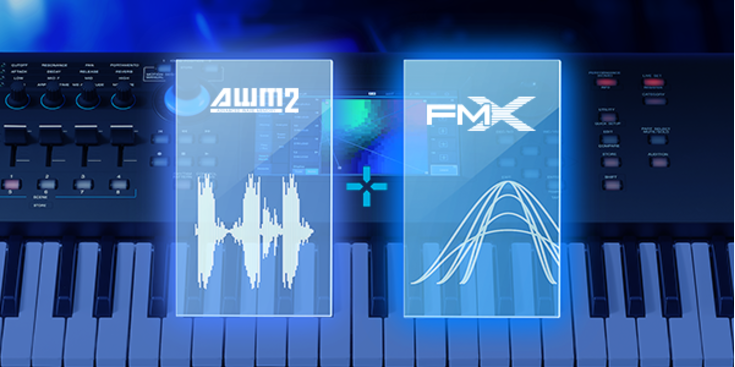
At that time, Yamaha was already working on a custom tone-generator chip containing a next-generation FM synthesis engine, and its planned completion coincided with development of the new flagship. One of the things that makes the FM tone generator unique is its ability to instantaneously morph from, for example, a sine wave with little or no overtones to a full-on metallic clang. Convinced that this capability would elevate the potential of the Super Knob and Motion Sequencer to new heights, the development team decided to combine the AWM2 engine with their new FM at the heart of their instrument.
Christened FM-X, this new FM engine boasted eight operators, which are the fundamental elements for creating and modulating sound in this type of synthesis, together with 88 algorithms. And as if that wasn’t enough, the operators could now also use waves other than sine waves, and new Spectral Skirt and Spectral Resonance parameters made it possible to shape the harmonics of those non-sine shapes. All this, combined with the ability for every FM parameter to be adjusted to a much greater degree of precision than ever before, thereby providing for smoother modulation between tones, made the new FM-X far more expressive than any FM synthesisers that preceded it.
The tone-generator section of the new flagship synthesiser would thus be built on the twin pillars of the AWM2 and FM-X engines. It is common for code names to be assigned to products currently under development, and the new flagship was no different: as the term Dual Algorithm Interactive Synthesiser had already been coined for the new multidimensional modulating instrument, the code name was formed from its abbreviation, “Daisy.”
In tandem with their work on the Daisy’s tone-generation specs and the core Motion Control feature—that is, modulation features such as the Super Knob and Motion Sequencer—the development team also evaluated different UI approaches and form-factor designs. Unlike the MOTIF music production synthesiser, the Daisy was always intended to be a live performance synth, so they armed it with new, powerful features for this particular environment, notable examples being Live Sets, which allow 16 sounds to be freely arranged on-screen and switched with a single tap; Seamless Sound Switching (SSS) to ensure that switching between sounds does not result in any audio drop out; and Scenes for instantaneously jumping between sound snapshots. And in designing the UI for the newly adopted touchscreen, the team gave careful consideration to ease of use, arranging the buttons on the Live Set screen in the most convenient way possible while maximising the distance between them.
The development team also fully revisited modes of button operation, aiming for an easy-to-understand, tactile UI. The layout and operation of buttons ultimately differed somewhat from those of the MOTIF, but the dogged insistence of the developers on operational ease undoubtedly benefited from their willingness to think outside the box, unconstrained by convention.
When it came to case design, the team was unshakeable in their pursuit of a range of new features, and in contrast to the highly-linear MOTIF, they advanced many design ideas centred more on the curve. In particular, a concave back surface had never before been seen on a Yamaha synth. Overall, they took an uncompromising approach to ease of use and comfort—one notable example being careful consideration of the curvature and finish of areas that come into contact with the palm of the hand when operating the pitch bend or modulation wheel.


Meanwhile, the DACs, analogue circuitry, and other sound-defining components were also optimised in an exhaustive fashion. Armed with more CPU power, the developers could produce more complex, higher resolution sounds, but these would ultimately need to be converted into analogue electrical signals if they were ever to be heard. For this reason, the analogue circuits by which the sounds depart the instrument and enter the audible world were perfected through meticulous, systematic listening tests and component selection. Users of software synthesisers are fully aware that their audio interface greatly affects the final sound and they can select accordingly, but the developer of the hardware synth must deliver a complete package, including this final link in the sound production chain. To satisfy these needs, the team created the Pure Analogue Circuit (PAC)—an audio output system that surpassed even the MOTIF XF in terms of musicality. Thanks to the PAC, the breathtaking sound of the Motion Control Synthesis Engine, which combined the new tone-generation system and Motion Control, could be heard in all its glory.


Now complete, the Daisy was officially named the MONTAGE in preparation for release. This name was inspired by the French for “assembly”, and it is also commonly used in the movie industry to refer to an editing process whereby multiple sections of film are pieced together to form a continuous whole. In selecting it, the developers hoped to inspire users of the new flagship synth to create totally new forms of musical expression by manipulating sound with the Motion Control feature. In May 2016, Yamaha proudly released its next-generation series of flagship synths in the form of the MONTAGE 6, 7, and 8.
Side Story: The Fabled MONTAGE RS

In January 2016, while Yamaha was announcing the May 2016 release of the new MONTAGE synth, developers were working day and night to meet the deadline. Just one month before the announcement, we had launched a project for the silver MONTAGE, a not-for-sale premium model. It was a passion project for the development team, who wanted to create a premium custom MONTAGE model for leading Japanese artist Ryuichi Sakamoto and, at the same time, a symbol for the next generation of MONTAGE synthesisers.
Exhaustive discussions on the colour resulted in two silver prototypes: the MONTAGE7 and the MONTAGE6. They were eventually collectively named “MONTAGE RS.” This synth exuded premium and quality, with a completely aluminium-panelled case and a finish so intricate as to suggest that every unit was custom-ordered. Later, Sakamoto and several other artists in Japan played MONTAGE RS synths at their live shows, so audiences did get a glimpse, but Yamaha never officially unveiled the model, so it took on legendary status as the “Fabled Silver MONTAGE.”