

5. MONTAGE M: The Culmination of 50 Years of Yamaha Synths
Seven years after the release of its flagship synthesiser, the MONTAGE, in 2016, Yamaha will release the MONTAGE M in October 2023, adding a new sound engine called the AN-X sound engine. In fact, the “M” in MONTAGE M signifies the fact that, with three sound engines, the instrument has evolved from a hybrid to a multi-synthesiser.
The new AN-X sound engine is a virtual analogue modelling type that uses digital technology to simulate an analogue synthesiser. Compared to the AN sound engine (also virtual analogue modelling) on the AN1x released in 1997, its specifications are significantly advanced to the point that, when combined with the array of real-time control of the MONTAGE, players can now enjoy more complex voice editing.

First, the basic structure has three oscillators (compared to two with the AN1x) as well as a separate noise oscillator. There are seven LFOs (up from two), and the filters have been upgraded to dual filters for more complex sound creation, for example using a high-pass filter and a low-pass filter at the same time, or creating two low-pass filter peaks and manipulating each one independently. Each oscillator can be routed directly behind the filters, making it possible to create unfiltered sound from certain oscillators. We also added parameters for more analogue-like simulation, namely Ageing (equipment age), and Voltage Drift (voltage fluctuation) which simulates variation in oscillator pitch and filter cutoff variations and other attributes.
Additionally, realistic analogue synthesiser behaviour is simulated down to the details, for example setting whether the oscillator phases are aligned or shifted by keystroke, or controlling the variation in pitch of each oscillator. The result is a warmer sound than expected of a digital synthesiser.

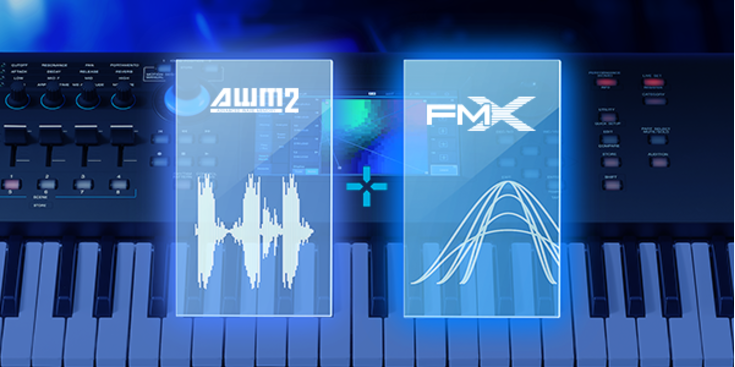
The AWM2 sound engine has also evolved substantially from the original MONTAGE, with the number of elements increased from 8 to 128. Normally, there are only eight elements, but opting to add elements allows more approaches and greater freedom in sound creation, for example layering eight or more waveforms simultaneously without using multiple parts, or creating voices with completely different instrument sounds or chords assigned to each key.


In this milestone year marking the 50th anniversary of Yamaha synthesisers, the MONTAGE M operating system was updated to version 2.0. The update includes many additions and improvements, starting with waveforms from the CFX, Yamaha’s flagship concert grand piano, which were released in 2022. Also included are the recently popular Shimmer Reverb effect and the Smart Morph function, which was previously only compatible with FM-X and can now be used with AN-X. Here, we will introduce another upgrade to 2.0: support for the MIDI 2.0 protocol released in 2019.

The MONTAGE M is Yamaha’s first MIDI 2.0-compatible synthesiser. By virtue of transferring MIDI data in 32- to 128-bit packets as opposed to the conventional 8-bit, MIDI 2.0 offers substantially higher data resolution than MIDI 1.0. Using control change data for transferring data on volume and other parameters as an example, with MIDI 1.0, only seven bits are available in the data area, resulting in maximum resolution of 128 steps (2⁷). The data for parameters like pitch bend comprises pairs of seven-bit bytes combined to create 14-bit bytes, yielding a maximum resolution of 16,384 steps (2¹⁴). MIDI 2.0 data areas feature 32 usable bits for a staggering maximum resolution of nearly 4.3 billion steps (2³² = 4,294,967,296). Velocity is also dramatically improved, with 16 bits for a maximum of 65,536 values.

The MONTAGE M8x also features a new keyboard to allow users to take full advantage of this high-resolution MIDI capability. For the FSX keyboards on previous models, velocity values are calculated by detecting the speed at which each key passes between several detection points throughout the stroke. In contrast, each key on the GEX keyboard on the MONTAGE M8x has coils attached to it and the keybed beneath it, and velocity is detected using the electromagnetic induction generated by the distance between the two coils. Pressing a key decreases the distance between the coils and changes the voltage generated at the ends of the coils (as the coils get closer to each other, the voltage decreases and a stronger sound is produced). Using the distance between coils means the vertical position of each key can be detected at many more points, increasing resolution and making it possible to capture velocity on a finer scale. The GEX keyboard also supports polyphonic aftertouch by virtue of detecting when a key is pressed deeper than normal based on the distance between the coils, making it suitable for the dramatically increased resolution of the MIDI 2.0 era.
With synthesisers, we tend to focus on the structure of the sound engine system—analogue or digital, AWM2 or FM—but the fact that after 50 years Yamaha continues to improve user interfaces, keyboards, and other components to give players what they want is proof that the company considers synthesisers to be musical instruments worthy of the very best effort in development.
Side Story: Hardware Programmers for the MONTAGE M
Yamaha exhibited samples of the PG-ANX and the PG-FMX, hardware programmers for the MONTAGE M synth, at Superbooth 2025, the world’s largest exhibition of electronic musical instruments, in Berlin, Germany, for three days starting May 8, 2025. The programmers, part of the Yamaha Synth 50th Anniversary Project, were designed to elicit the sound creation potential and showcase the appeals of Yamaha’s flagship synthesiser.

In December 2024, during a special roundtable discussion with former Yamaha developers at Yamaha’s headquarters, Dr. John Chowning, inventor of the FM tone generator, said, “No new innovation can be created without respect for the legacy of the past.” As if to embody that statement, Yamaha is constantly on the lookout for new ways to innovate with the latest models while paying homage to the CS-80, the DX1, and other legendary synths. Reflecting on the 50th anniversary of Yamaha synths, in 2025, we moved on to the theme of creating messages for the future. In response, we created Hardware Programmers for the MONTAGE M to serve as the symbolic model for efforts on that theme. Among the things we kept in mind while developing the programmers was the TRX programmer Dr. Chowning used to develop the GS1 prototype.
The development team was always committed to creating a prototype with lots of knobs and switches to boldly portray the very best a synthesiser could be. This sentiment spawned the idea of creating hardware programmers that would maximise the sound potential of the MONTAGE M to coincide with the 50th anniversary of Yamaha synths. The design process for these programmers focused not on physical size, but on enabling users to intuitively grasp the flow of sound and the parameters with a glance at the panel. The programmers contain all the key parameters that form the core of both AN-X and FM-X tone generators, allowing users to select any of the eight parts for each tone generator for real-time, intuitive sound creation. Users can also utilise the MONTAGE M and the programmers simultaneously to create sounds. Additionally, the programmers feature a REFLECT button to synchronise MONTAGE M voice settings to the programmers, and an INITIALIZE button to reset the voices to their defaults. However, even though the goal was to have no physical constraints, much trial-and-error was required so that the panel layout was not excessively large.
Amid the current ubiquity of software synthesisers, Yamaha’s bold move to develop a pure analogue interface without a built-in tone generator came as a surprise to many people. Many said that it made them realise that simultaneous control of multiple parameters would immediately expand the expressive power of their sound, and that it reminded them of the benefits that only hardware can provide. One MONTAGE M user commented that seeing the knobs and buttons lined up physically helped them better understand the structure and reinforce their confidence in the sound potential of the MONTAGE M.